

How Much “Fuel” Does a Rocket Need to Reach the Highest Possible Altitude?
1. The challenge
Space rockets must generate enough acceleration to overcome Earth’s gravity. However, there is an important problem: the fuel needed to produce thrust also increases the total mass of the vehicle.
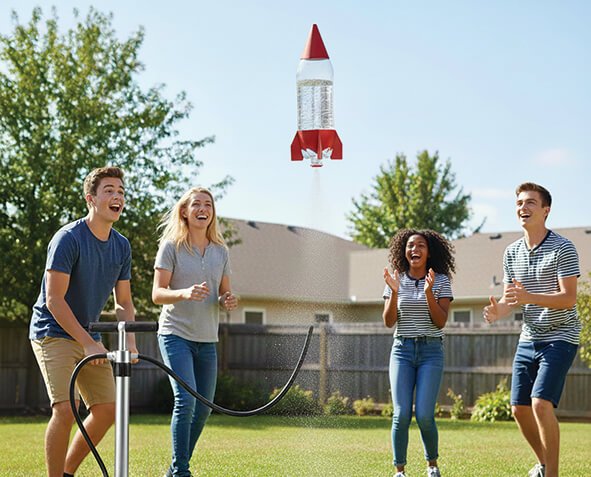
In this experiment, we will build a hydrodynamic rocket that uses water and compressed air as its propulsion source. By changing the amount of water inside the bottle, we can observe how the flight time changes and estimate the height reached.
The objective is to discover which volume of water allows the rocket to rise the highest.
2. Importance in the real world
Engineers who design space vehicles constantly face a balance problem: generating enough thrust without increasing the rocket’s mass too much.
For a spacecraft to lift off, the thrust produced by its engines must be greater than the total weight of the vehicle. If the rocket is too heavy, it will not be able to accelerate enough to leave Earth’s surface.
For this reason, designing space missions requires very precise calculations of:
- The mass of the spacecraft
- The amount of fuel required
- The power of the engines
Even small variations in these values can determine whether a space mission succeeds or fails.
3. Mental model of the experiment
The rocket operates according to Newton’s Third Law, which states that every action produces an equal and opposite reaction.
In this experiment, the following occurs:
- Compressed air increases the pressure inside the bottle
- That pressure pushes the water downward and out of the nozzle
- The rocket receives a force in the opposite direction and rises upward
The water acts as reaction mass—the material expelled by the rocket to generate thrust.
However, an interesting dilemma appears:
- If there is too little water, the thrust will be small.
- If there is too much water, the rocket becomes too heavy.
This experiment allows us to investigate which intermediate point is the most efficient.
4. Common misconception
“Rockets need air to push against in order to move.”
In reality, rockets work perfectly in the vacuum of space.
Thrust does not come from pushing against air. Instead, it comes from expelling mass at high speed. When gases leave the engine in one direction, the rocket receives a force in the opposite direction that propels it forward.
The same principle applies in our experiment: the water expelled from the bottle produces the force that launches the rocket.
5. Expanding the challenge
During the experiment, the total flight time of the rocket is measured. With this value, it is possible to estimate the height reached using the equations of motion with constant acceleration.
Assuming the motion is vertical and the acceleration due to gravity is:
We can analyze the rocket’s ascent. At the highest point of the flight, the final velocity is equal to zero. This allows us to estimate the initial launch velocity.
By repeating the experiment with different water volumes (for example 200 mL, 400 mL, 600 mL, etc.), you can construct a graph of maximum height versus water volume.
The most interesting result is that a characteristic pattern usually appears:
- The height increases at first when water is added
- It reaches a maximum point
- Then it decreases when the rocket becomes too heavy
That maximum point represents the optimal “fuel” amount for the system.
This type of analysis is very common in engineering and is used to optimize the performance of engines, turbines, and transportation systems.
6. Scientific microhistory
In 1926, American engineer Robert H. Goddard carried out one of the first successful launches of a liquid-fuel rocket. The device only reached a few meters in altitude, but it demonstrated that reaction engines could work in a controlled way.
At the time, many scientists believed that rockets would not work in the vacuum of space.
However, Goddard showed that thrust does not depend on air, but on the expulsion of gases at high speed.
Decades later, the same principle made it possible to build the large rockets that carried astronauts to the Moon.
7. Final question
If a small bottle rocket can rise using only water and compressed air…
What speed must a real rocket reach in order to completely escape Earth’s gravity?