

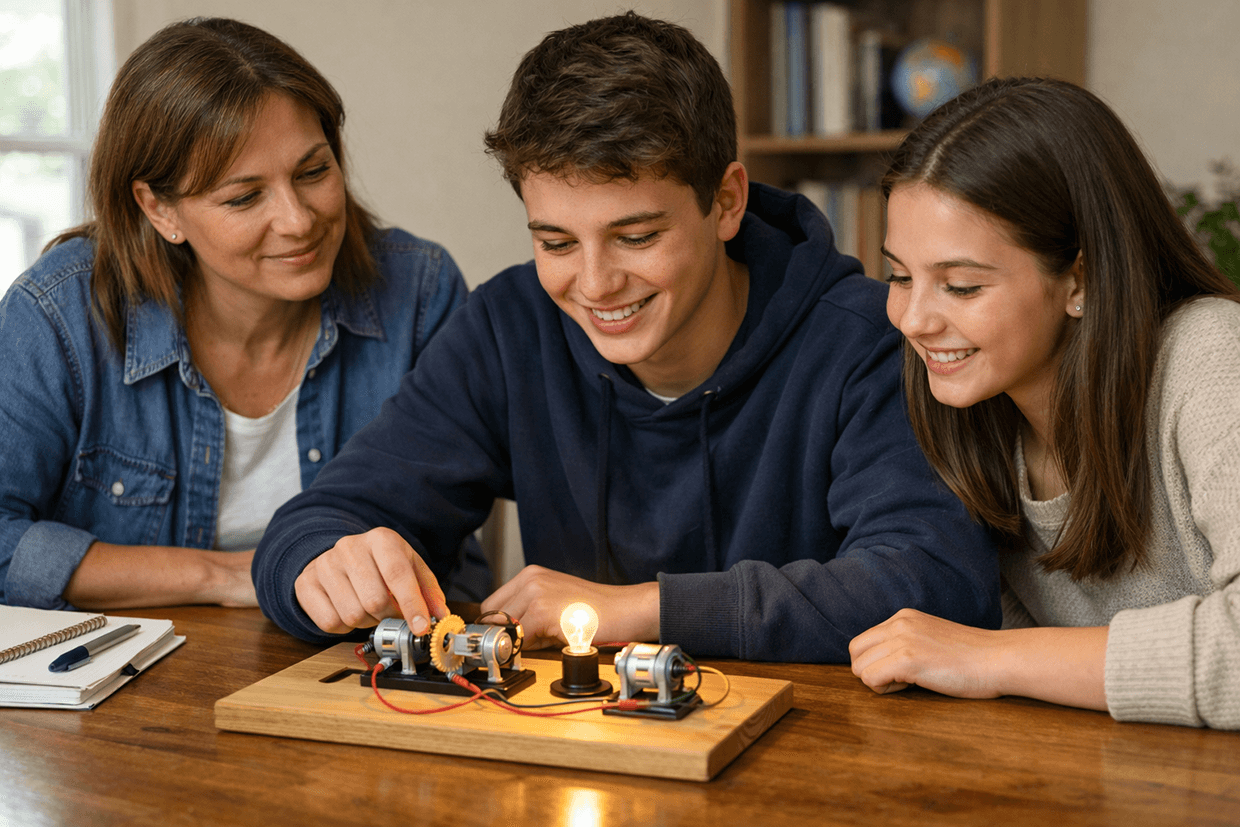
Is It Possible to Generate Energy Using an Electric Motor?
1. The challenge
At first glance, it might seem possible.
If you connect an electric motor to a battery, the motor begins to spin. If that motor is used to spin a second motor, the second one can generate electricity. This might give the impression that we are creating additional energy.
However, when we carefully measure the system, we discover something important: the energy obtained is always less than the energy supplied.
The difference is lost in the form of heat, friction, and sound.
2. Importance in the real world
Electric motors and generators are essential in modern life. For example:
- Power plants use turbines that spin generators to produce electricity.
- Electric vehicles use motors that convert electrical energy into motion.
- Wind turbines transform the energy of the wind into electricity.
In all these systems, the same thing happens as in this experiment: some energy is always lost, which means that no device can be 100% efficient.
3. Mental model of the experiment
Imagine that energy moves through the system like water flowing through a series of containers.
- The battery provides electrical energy.
- The first motor converts that energy into motion.
- The second motor converts the motion back into electricity.
But at each step, something important happens:
- Some energy is transformed into heat.
- Another portion is lost due to friction.
- A small fraction becomes sound.
For this reason, the energy that reaches the end of the system is always smaller than the energy that entered it.
4. Common misconception
“We could build a machine that produces more energy than it consumes.”
This idea is known as a perpetual motion machine.
For centuries, many people attempted to build devices capable of generating infinite energy without consuming fuel. However, every attempt ultimately failed.
The reason is simple: the Law of Conservation of Energy states that energy cannot be created or destroyed—it can only be transformed.
This experiment illustrates that principle directly.
5. Expanding the challenge
The challenge proposes analyzing the energy consumption in your home.
Electric bills usually indicate consumption in kilowatt-hours (kWh). This unit represents the energy consumed by a 1000-watt device operating for one hour.
To convert this value to joules:
With this information, you can estimate:
- How much energy your household uses each day
- How much that energy costs
- Which appliances consume the most electricity
This type of analysis is essential for improving energy efficiency in homes and cities.
6. Scientific microhistory
During the 19th century, many inventors attempted to build machines capable of operating forever without consuming energy. Some even claimed to have discovered the secret of perpetual motion.
However, all of these devices had the same problem: sooner or later, they stopped. Friction, heat, and other losses gradually reduced the available energy.
The development of thermodynamics helped scientists understand why this happens. They demonstrated that no machine can convert all the energy it receives into useful work.
Since then, engineers have understood that the most efficient machines are not those that create energy, but those that use existing energy as effectively as possible.
7. Final question
If no machine can ever be perfectly efficient…
How close have modern technologies come to reaching the maximum possible efficiency?