

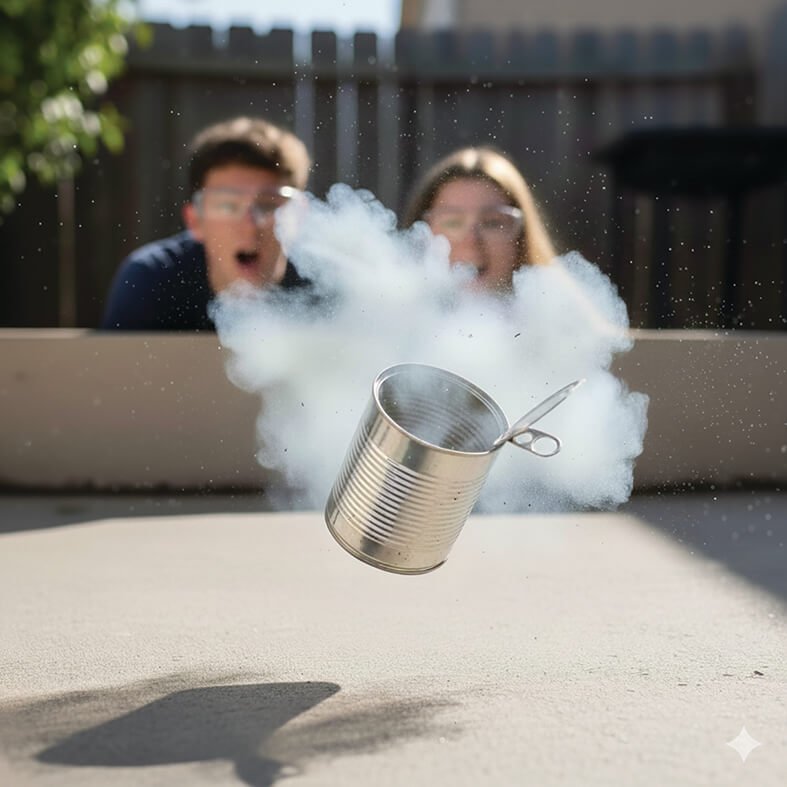
How Can an Ordinary Material Like Flour Cause an Explosion?
1. The challenge
The key idea is surface area.
When a combustible material is dispersed into very fine particles, each particle becomes surrounded by oxygen. If a source of heat appears, the chemical reaction can occur very rapidly in thousands of points at the same time, releasing energy suddenly.
Under these conditions, combustion happens almost instantaneously, producing an explosion.
2. Importance in the real world
This phenomenon is not limited to laboratory experiments. It occurs in many industrial environments.
In places where fine dust is suspended in the air—such as flour mills, sawmills, grain silos, or sugar-processing plants—a small spark can trigger extremely dangerous explosions.
For this reason, strict safety rules exist in these industries:
- Do not smoke near combustible dust.
- Use tools that do not produce sparks.
- Wear anti-static clothing and equipment.
- Maintain proper ventilation systems.
Understanding this phenomenon helps prevent real accidents.
3. Mental model of the experiment
Imagine a sugar cube and the same sugar ground into fine powder.
- The cube has little surface exposed to the air.
- The powder has thousands of tiny surfaces in contact with oxygen.
When you blow flour into the container, you create something similar to a fuel cloud. Each particle can react with oxygen at the same time.
The candle provides the initial energy, and an extremely rapid combustion occurs. The expansion of hot gases is what produces the explosion.
4. Common misconception
“Only explosives like dynamite or gasoline can explode.”
In reality, many combustible materials can explode when they are finely dispersed as dust and mixed with air.
Examples include:
- Flour
- Sugar
- Wood dust
- Pulverized coal
- Aluminum powder
The danger does not depend only on the material itself, but also on its physical form and the conditions of the environment.
5. Expanding the challenge
The challenge proposes measuring the energy released during the explosion. There are several creative ways to estimate it.
Indirect method: lid height
You can measure how high the container lid rises after the explosion. The greater the energy released, the higher the lid will be lifted.
By repeating the experiment several times, you can compare results and estimate the relative energy released.
Object motion method
Place small lightweight objects on the lid (for example, coins).
After the explosion, observe:
- How far they move
- How many fall off the container
These observations allow you to compare the intensity of the explosion in different trials.
6. Scientific microhistory
For many years, unexpected explosions were recorded in grain silos and flour mills around the world. At first, no one clearly understood what was happening. There was no dynamite or liquid fuel—only fine dust suspended in the air.
Over time, engineers discovered the cause.
When grain or flour becomes pulverized and forms a cloud inside a closed space, each particle can react with oxygen at the same time. If a spark appears—from a machine, static electricity, or even a cigarette—the combustion spreads almost instantly.
Today, industries that work with combustible dust use special ventilation systems, spark detectors, and anti-static equipment to prevent these accidents.
Chemistry does not only explain what we see in the laboratory—it also helps us design safer environments and prevent real disasters.
7. Final question
If fine dust can be explosive…
What other everyday materials might become dangerous when their physical form changes?