

How Can a Chemical Reaction Produce the Force Needed to Launch a Rocket?
1. The challenge
When two substances react chemically, they can produce new materials and release energy.
In this experiment, vinegar (acetic acid) reacts with sodium bicarbonate and produces carbon dioxide (CO₂). This gas accumulates inside the bottle and increases the internal pressure.
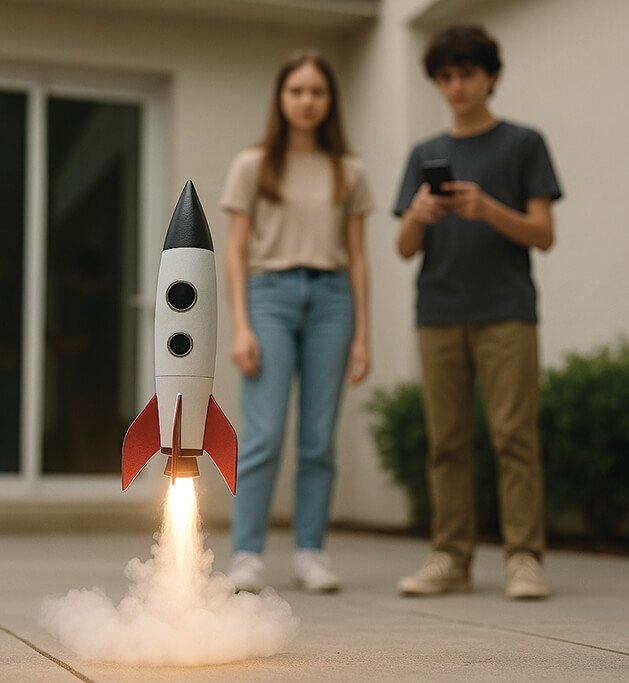
When the pressure becomes greater than the force holding the stopper in place, the gas escapes suddenly and pushes the rocket upward.
The result is a visible example of the principle of action and reaction.
2. Importance in the real world
Real rockets operate using a similar principle: they expel gases at very high speed in one direction, and as a reaction, the vehicle moves in the opposite direction.
The difference lies in the scale and the amount of energy involved.
In space rockets, special fuels react with liquid oxygen to produce enormous quantities of extremely hot gases. The continuous expulsion of these gases is what allows rockets to lift tons of mass and escape Earth’s gravity.
Although our rocket is small, it demonstrates the same physical principle used in space missions.
3. Mental model of the experiment
Imagine you are standing on a skateboard and you throw a very heavy ball backward.
When you throw it with force, your body moves slightly forward. This happens because every action produces an opposite reaction.
Something similar occurs in the rocket:
- The gas is expelled downward
- The rocket is pushed upward
The bottle acts as a pressure chamber that accumulates gas until the stopper is suddenly expelled.
4. Common misconception
“A rocket needs fire or combustion to fly.”
Not necessarily. What a rocket really needs is to expel mass in one direction in order to generate a force in the opposite direction.
For this reason, there are several types of rockets:
- Chemical rockets (combustion)
- Water rockets
- Compressed-gas rockets
Our experiment shows that even a simple chemical reaction can generate the gas needed to produce thrust.
5. Expanding the challenge
The challenge proposes calculating the exact amount of sodium bicarbonate needed so that no reactant remains in excess.
The chemical equation is:
The ratio between acetic acid and sodium bicarbonate is 1 : 1 in moles.
This means that:
- 1 mole of acetic acid reacts with 1 mole of sodium bicarbonate
If you know the concentration of the vinegar (about 5%) and the volume used, you can estimate the amount of acid present and calculate how many grams of bicarbonate will react exactly.
These types of calculations are fundamental in chemistry and are known as stoichiometry.
6. Scientific microhistory
In 1926, the American scientist Robert H. Goddard launched one of the first liquid-fuel rockets in history. The device was only a few meters long and lifted off from a snow-covered field in Massachusetts.
The flight lasted only a few seconds and reached a modest height. However, that small experiment demonstrated that propulsion could be controlled through chemical reactions.
Decades later, the same principle made it possible to build the enormous rockets that carried astronauts to the Moon.
Many of the advances that make space exploration possible today began with simple experiments—very similar in spirit to the one you are performing now.
7. Final question
If a small chemical reaction can launch a bottle into the air…
How much energy does a real rocket need to completely escape Earth’s gravity?